EVBatteryRecycling
Solutions by Partner

BESS Integrators — Grade-A Second-Life Modules

Impedance-matched, capacity-binned modules delivered in string-ready sets — the repeatable feedstock stationary storage integrators need to build bankable second-life BESS at a fraction of new-cell cost.

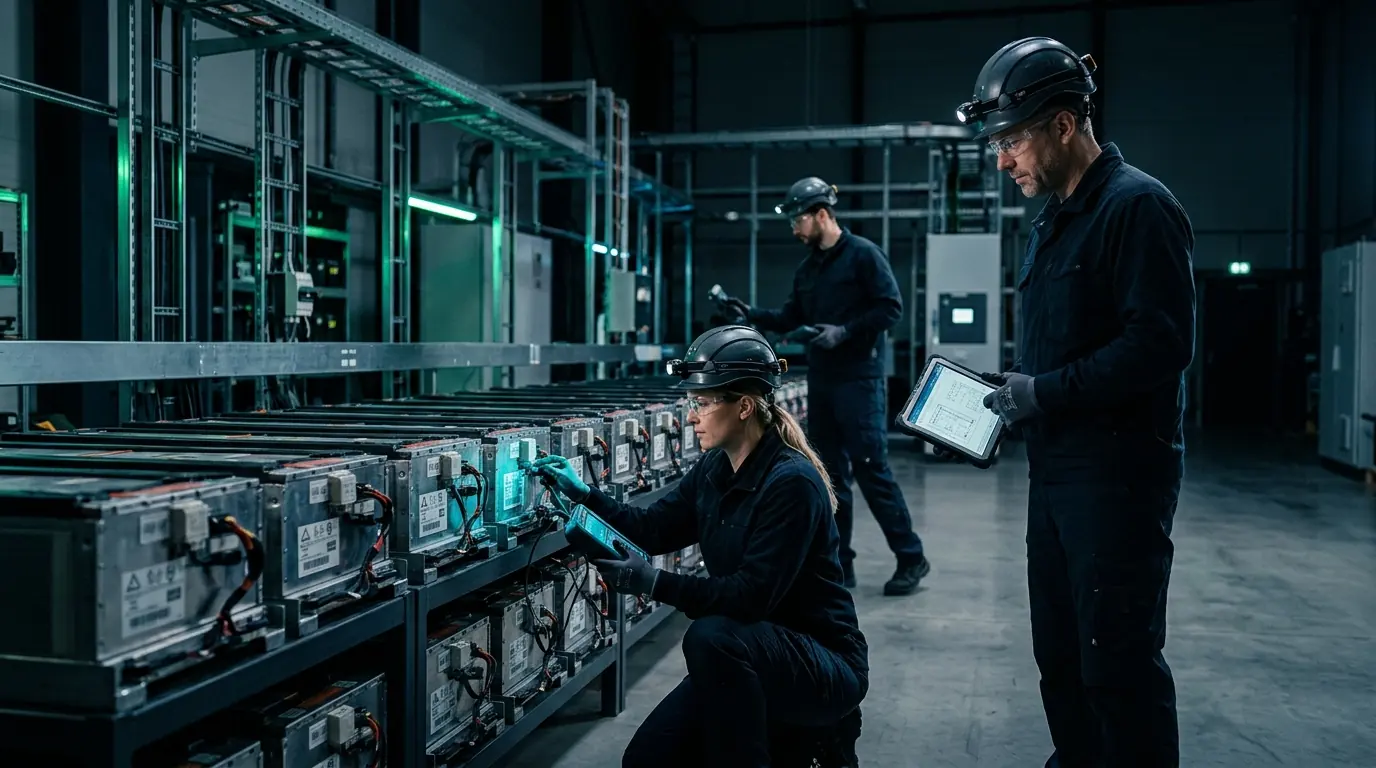
Integrator engineers inspecting a row of graded second-life modules ready for rack integration

Modules shipped

240,000

Grade A and B

String capacity match

2.5%

Max spread within a string

Warranty

5 yrs

Capacity-backed

Cost vs new cells

46%

Typical delivered saving

Overview

The short version

Stationary storage is where retired EV modules can create the most value, but only if the supply is predictable. Integrators need modules that behave alike inside a string, arrive with data their battery management system can use, and are backed by a warranty a project financier will accept. Randomly sourced used modules rarely meet those tests, which is why many second-life projects stall after the pilot.

Our supply model is built around repeatability. Modules are graded on the same benches, binned to tight capacity and resistance bands, and allocated from stock across the network so that string sets come from consistent chemistry and format. Each set arrives with per-module data and a capacity-backed warranty, which makes second-life systems far easier to engineer and finance.

Capabilities

What this programme includes

01

Capacity binning

Modules grouped into 2.5% capacity bands so strings age uniformly.

02

Impedance matching

EIS-derived internal resistance matched across each delivered string set.

03

UL 1974 evaluated process

Repurposing workflow evaluated against the standard for repurposed batteries.

04

BMS integration data

Per-module OCV curves, resistance and thermal coefficients delivered as machine-readable datasets.

05

Guaranteed SOH bands

Contracted delivery at 75–85% SOH with capacity-backed warranty.

06

Container build option

Turnkey 500 kWh–3 MWh containers assembled at our Gothenburg campus.

Workflow

How engagement runs

  1. 1

    Spec intake

    Target chemistry, voltage window, string architecture and volume defined.

  2. 2

    Reserve inventory

    Matching modules reserved from graded stock across hubs.

  3. 3

    Bin & test

    Final capacity and impedance verification with per-module datasheet.

  4. 4

    Ship or integrate

    String sets shipped, or built into containerised systems.

Specification

At a glance

ParameterDetail
ChemistriesLFP prismatic, NMC 811 cylindrical
SOH band75–85% guaranteed
Warranty5 years / 2,000 cycles
Lead time6–10 weeks
StandardsUL 1974 evaluated, IEC 62933 tested
BESS Integrators — Grade-A Second-Life Modules — technical specification.
01

Engineering a system around second-life modules

Second-life modules need conservative design choices. Charge voltage is usually derated slightly, C-rates are kept moderate and thermal management is designed for the most sensitive module in the string. A new battery management system with accurate per-module monitoring is essential, because inherited automotive electronics are rarely suitable for stationary duty.

Enclosure design matters as much as the cells. Fire-rated containers with gas detection, ventilation and suppression, plus clear separation between racks, are standard practice. Commissioning cycles then confirm round-trip efficiency, state-of-charge accuracy and that all protection functions trip correctly.

  • Derate charge voltage and C-rate for longer life
  • Use a new BMS with per-module monitoring
  • Design thermal management for the weakest module
  • Include gas detection and fire-rated enclosures
02

Choosing the right applications

Second-life systems perform best where duty is steady and predictable. Energy shifting for solar, backup power and peak shaving suit graded modules well. High-power services such as fast frequency response demand more from cells and are usually better served by new batteries.

Matching application to grade also improves economics: grade A modules can take daily cycling, while grade B modules are often a better fit for backup and lower-cycle duties where capacity fade has less effect on revenue.

ApplicationSuitable gradeNotes
Solar energy shiftingA or BDaily cycling at moderate power
Telecom and site backupBInfrequent, shallow discharge
Commercial peak shavingARegular cycling, predictable load
EV charging buffersAShort high-power bursts, managed carefully
Fast frequency responseUsually new cellsHigh C-rate and fast response
Application fit for graded second-life modules.

Field note

Plan decommissioning from day one: every second-life module will eventually need to go to a refiner.
Answers

Technical FAQ

Are second-life EV batteries reliable for grid storage?

Yes, when modules are capacity-binned and impedance-matched. Modules graded at 75–85% SOH with a spread under 2.5% within a string typically deliver 2,000+ further cycles in stationary duty, where C-rates are far gentler than automotive use.

What does a second-life BESS cost compared with new cells?

Delivered second-life module cost is generally 40–55% below equivalent new cells. Total system cost saving is smaller — around 25–35% — once enclosure, BMS, inverter and integration are included.

Can we mix modules from different vehicle models?

It is not recommended within a string. Sets are allocated from a single chemistry and format so modules age evenly.

What data do we receive with each module?

Measured capacity, internal resistance, impedance results, open-circuit voltage behaviour and serial history, in a machine-readable format for BMS configuration.

What happens when the system reaches end of service?

Modules can be returned under a take-back arrangement for refining, with the same chain-of-custody and certificates as first-life packs.

Scope a programme with us

Share volumes, sites and reporting needs. We come back with a take-back structure, logistics plan and pricing within 48 hours.