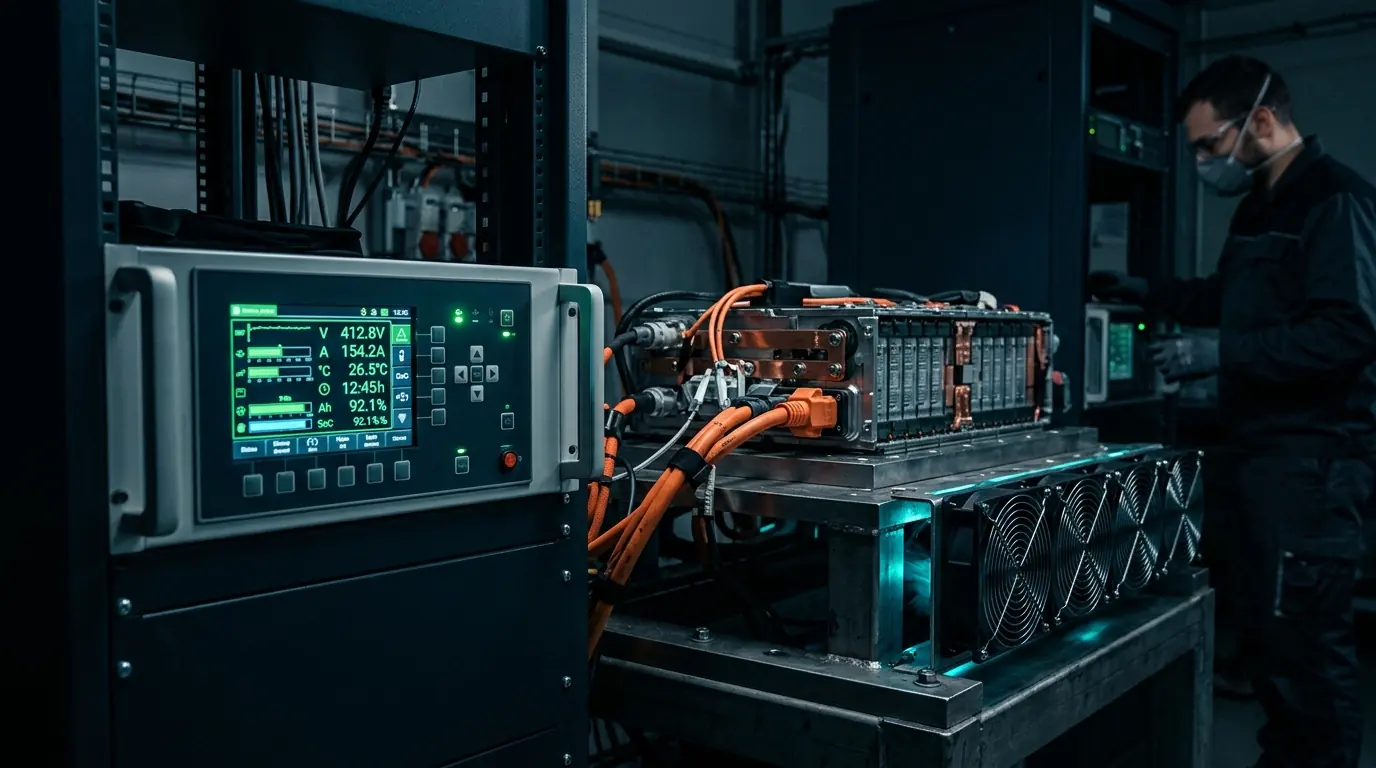
Why pack-level SOH is not enough
A pack is only as good as its weakest module in automotive use, but in second life the modules can be separated and sold on their own merits. A single weak module can drag a whole pack down on a BMS reading, while the rest of the pack remains perfectly usable. Testing at module level unlocks that value.
The reverse also happens: a pack can report reasonable health while one module has a high self-discharge rate or a failing cell. Without module-level checks, that module could end up in a storage system and cause a fault years later.
| Measurement | What it reveals |
|---|---|
| Reference capacity cycle | Usable energy compared with nameplate |
| DC internal resistance | Power fade and heat generation |
| Cell voltage spread | Weak or imbalanced cells |
| Self-discharge over rest | Internal short-circuit risk |
| Thermal imaging | Hot spots and connection defects |
Getting reliable results
Measurement quality depends on control. Temperature has a large effect on capacity and resistance, so tests are run in a temperature-controlled chamber and results are compensated to a reference condition. Modules are also rested before testing so that recent charge or discharge does not distort voltage readings.
Every result is linked to the module serial and stored as a signed record. That record travels with the module into second life and supports warranty claims, audits and battery passport updates where they apply.
- Temperature-controlled test environment
- Rest period before measurement
- Calibrated equipment with traceable records
- Serial-linked digital datasheets
Field note