Birmingham, England cell grading plant
How Birmingham — West Midlands Grading Works decides reuse or refining for every module — test sequence, grade bands, outputs and the sites that feed it.

Throughput
16,000 TPA
Process stages
6
Feeder sites nearby
6
Operating since
2021
From intake to grade assignment
- 1
Intake & safety triage
Packs are logged, thermally imaged and screened for swelling, coolant ingress or venting before entering the bench area.
- 2
Controlled de-energising
Residual energy is discharged to a safe state of charge with regenerative load banks and recorded per serial number.
- 3
Module-level capacity test
Full charge-discharge cycling at C/3 establishes usable capacity, internal resistance and cell-to-cell balance.
- 4
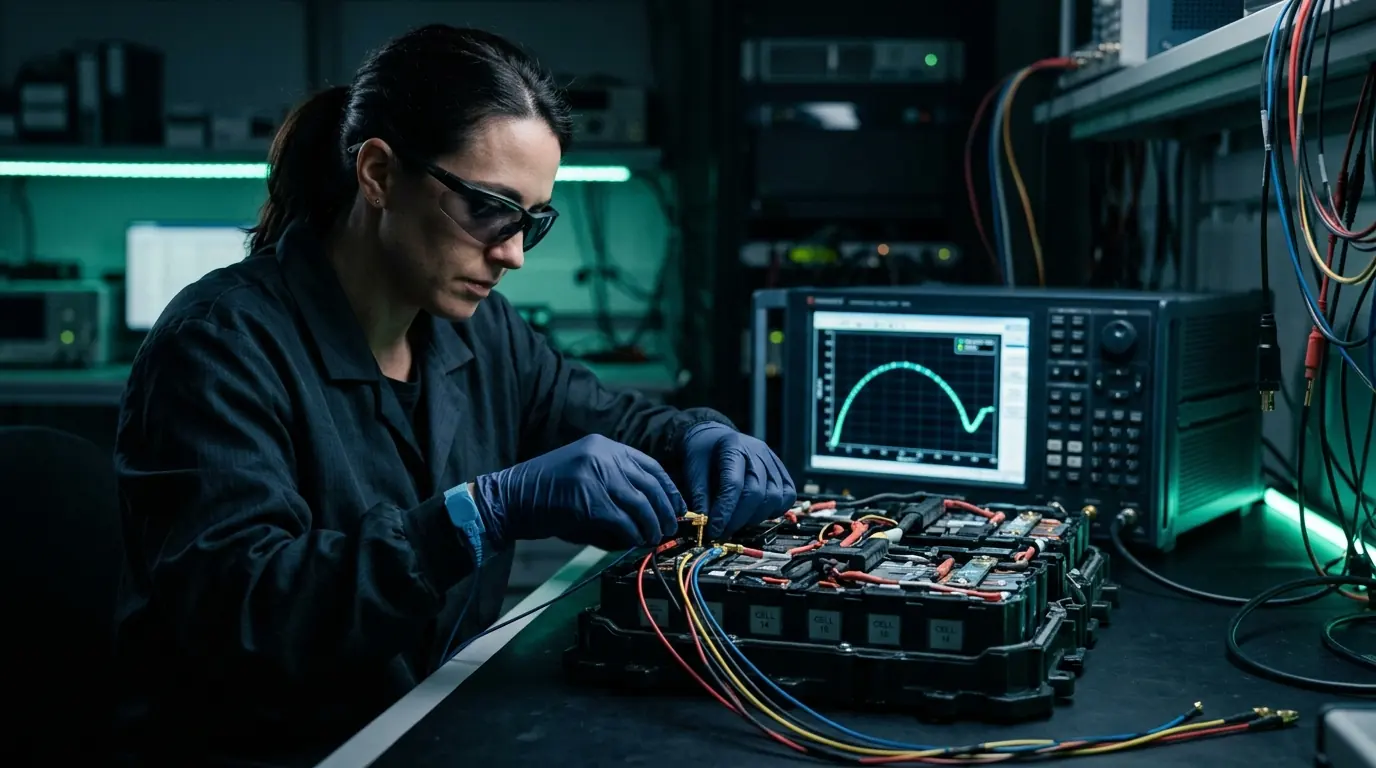
EIS fingerprinting
1 mHz–10 kHz impedance sweeps separate SEI growth, lithium plating and contact resistance degradation modes.
- 5
AI optical inspection
Machine-vision inspection of busbars, welds and cell cans flags mechanical defects that block second-life reuse.
- 6
Grade assignment
Grade A (≥85% SOH), B (75–85%), C (65–75%) and D routes are assigned, with D-grade material released to refining.
Acceptance criteria
| Criterion | Requirement |
|---|---|
| Accepted feed | Whole packs and modules from intake yards and fleets |
| State of charge | Below 30% on arrival, recorded per serial |
| Condition | Damaged units declared and routed to quarantine |
| Documentation | Manifest with serials, chemistry and prior history |
Grade bands and routes
| Grade | Route |
|---|---|
| Grade A (85%+) | Grid-tied and commercial storage builds |
| Grade B (75–85%) | Telecom backup and solar buffering |
| Grade C (65–75%) | Low-duty backup, short warranty |
| Grade D (<65%) | Discharge and refining feed |
Why Birmingham, England
Birmingham and the West Midlands are the traditional heart of UK vehicle manufacturing, with engineering centres, suppliers and battery development programmes across the region. The grading works opened on the Tyseley Industrial Estate in 2021 to give the UK its own module-level grading site, keeping British material in the country for testing. Its catchment covers England, Wales and Scotland. It opened as UK EV registrations accelerated.
Its 16,000 TPA of capacity covers passenger-car packs from dealers and dismantlers, taxi and bus fleet retirements, and development material from UK engineering programmes. Black cab and bus fleets are a distinctive part of its intake, with pack formats and duty cycles unlike typical private cars. Reusable modules go on to second-life builds, and the rest are sent for black mass production.
Permitting
Waste Batteries and Accumulators Regulations 2009
The works operates under Environment Agency permitting in England and the UK waste batteries regulations, which place producer responsibility obligations on those placing batteries on the market. Transport follows UK dangerous goods rules based on ADR.
Technical strengths
UK grading base
Keeps UK material in the country for testing.
Engineering material
Handles packs from UK development programmes.
Taxi and bus expertise
Experienced with the pack formats and duty cycles of UK fleets.
Sites that feed Birmingham, England
Packs and modules arrive from these intake sites.
Birmingham, England plant: technical questions
How long does grading take?
Standard passenger modules are graded within about five working days of intake; large-format bus and truck packs take longer because of disassembly.
What tests are run on each module?
A full capacity cycle, DC internal resistance, impedance spectroscopy and optical inspection of busbars, welds and cans.
Does Birmingham operate under EU rules?
The UK has its own battery and waste rules, and the site operates under Environment Agency permits.
Can taxi fleets use the Birmingham site?
Yes. Depot collections can be arranged for fleet operators.
Damaged or defective packs are handled under a separate quarantine protocol — flag them in the form and the team calls you back the same day.
Need modules graded?
Share pack counts, chemistry and condition for a grading slot and indicative value split.