Tuas, Singapore cell grading plant
How Singapore — Tuas Diagnostics Hub decides reuse or refining for every module — test sequence, grade bands, outputs and the sites that feed it.

Throughput
18,000 TPA
Process stages
6
Feeder sites nearby
6
Operating since
2021
From intake to grade assignment
- 1
Intake & safety triage
Packs are logged, thermally imaged and screened for swelling, coolant ingress or venting before entering the bench area.
- 2
Controlled de-energising
Residual energy is discharged to a safe state of charge with regenerative load banks and recorded per serial number.
- 3
Module-level capacity test
Full charge-discharge cycling at C/3 establishes usable capacity, internal resistance and cell-to-cell balance.
- 4
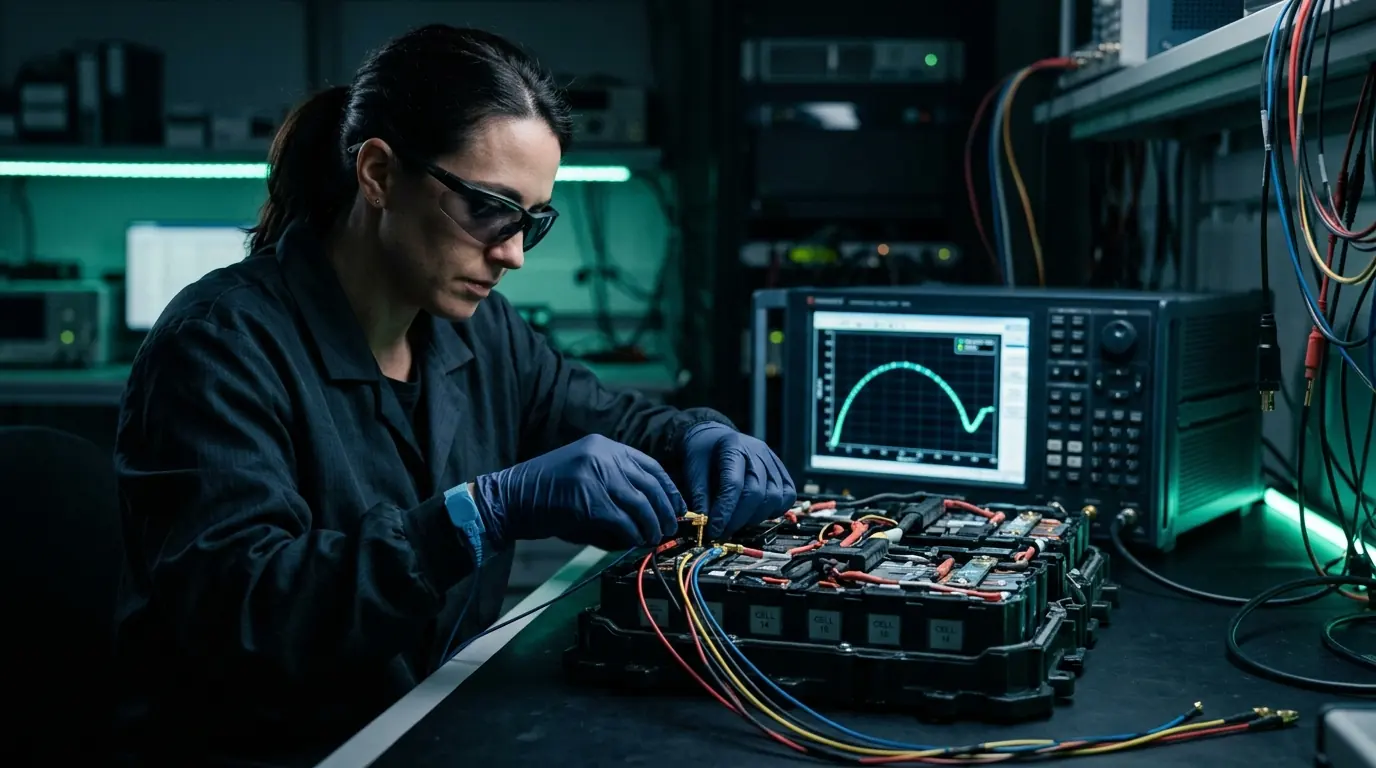
EIS fingerprinting
1 mHz–10 kHz impedance sweeps separate SEI growth, lithium plating and contact resistance degradation modes.
- 5
AI optical inspection
Machine-vision inspection of busbars, welds and cell cans flags mechanical defects that block second-life reuse.
- 6
Grade assignment
Grade A (≥85% SOH), B (75–85%), C (65–75%) and D routes are assigned, with D-grade material released to refining.
Acceptance criteria
| Criterion | Requirement |
|---|---|
| Accepted feed | Whole packs and modules from intake yards and fleets |
| State of charge | Below 30% on arrival, recorded per serial |
| Condition | Damaged units declared and routed to quarantine |
| Documentation | Manifest with serials, chemistry and prior history |
Grade bands and routes
| Grade | Route |
|---|---|
| Grade A (85%+) | Grid-tied and commercial storage builds |
| Grade B (75–85%) | Telecom backup and solar buffering |
| Grade C (65–75%) | Low-duty backup, short warranty |
| Grade D (<65%) | Discharge and refining feed |
Why Tuas, Singapore
Tuas is Singapore's main industrial area and the site of its next-generation port. The diagnostics hub opened on Tuas South Avenue 6 in 2021 to grade packs from Singapore and South-East Asia, where electrification of taxis, buses and delivery fleets is gathering pace. Its catchment covers Singapore and nearby markets, including Malaysia and Indonesia, where consolidated loads are received under the required import permits.
At 18,000 TPA, the hub tests fleet and passenger packs and supports regional trading of graded modules. Singapore's role as a trading and logistics centre makes it a practical base for supplying reusable modules to buyers across the region. Packs that do not qualify for reuse are consolidated and sent for processing, and every tested pack receives a serial-level grade report.
Permitting
Resource Sustainability Act 2019 and the Environmental Protection and Management Act
The hub operates under Singapore National Environment Agency requirements, including its producer responsibility scheme for e-waste. International shipments follow Basel Convention procedures where applicable.
Technical strengths
South-East Asian base
Grading capacity for the wider region.
Port access
Next to Singapore's Tuas port.
Module trading support
Graded modules can be supplied to regional buyers.
Sites that feed Tuas, Singapore
Packs and modules arrive from these intake sites.
Tuas, Singapore plant: technical questions
How long does grading take?
Standard passenger modules are graded within about five working days of intake; large-format bus and truck packs take longer because of disassembly.
What tests are run on each module?
A full capacity cycle, DC internal resistance, impedance spectroscopy and optical inspection of busbars, welds and cans.
Does Singapore accept regional batteries?
Yes, subject to import rules.
What happens after grading?
Reusable modules may be supplied to buyers, and the rest are sent for processing.
Damaged or defective packs are handled under a separate quarantine protocol — flag them in the form and the team calls you back the same day.
Need modules graded?
Share pack counts, chemistry and condition for a grading slot and indicative value split.