Hosur, Tamil Nadu cell grading plant
How Bengaluru — Hosur Diagnostics Centre decides reuse or refining for every module — test sequence, grade bands, outputs and the sites that feed it.

Throughput
14,000 TPA
Process stages
6
Feeder sites nearby
6
Operating since
2021
From intake to grade assignment
- 1
Intake & safety triage
Packs are logged, thermally imaged and screened for swelling, coolant ingress or venting before entering the bench area.
- 2
Controlled de-energising
Residual energy is discharged to a safe state of charge with regenerative load banks and recorded per serial number.
- 3
Module-level capacity test
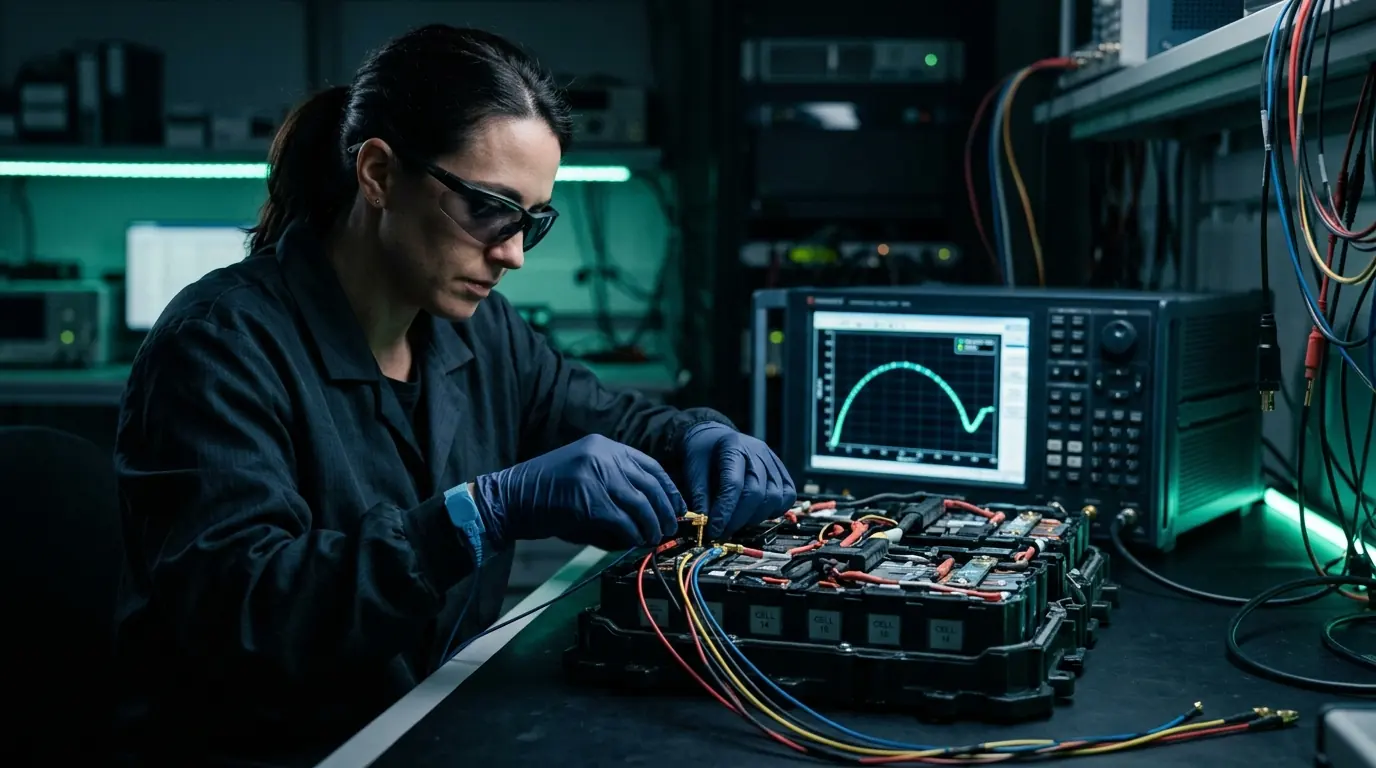
Full charge-discharge cycling at C/3 establishes usable capacity, internal resistance and cell-to-cell balance.
- 4
EIS fingerprinting
1 mHz–10 kHz impedance sweeps separate SEI growth, lithium plating and contact resistance degradation modes.
- 5
AI optical inspection
Machine-vision inspection of busbars, welds and cell cans flags mechanical defects that block second-life reuse.
- 6
Grade assignment
Grade A (≥85% SOH), B (75–85%), C (65–75%) and D routes are assigned, with D-grade material released to refining.
Acceptance criteria
| Criterion | Requirement |
|---|---|
| Accepted feed | Whole packs and modules from intake yards and fleets |
| State of charge | Below 30% on arrival, recorded per serial |
| Condition | Damaged units declared and routed to quarantine |
| Documentation | Manifest with serials, chemistry and prior history |
Grade bands and routes
| Grade | Route |
|---|---|
| Grade A (85%+) | Grid-tied and commercial storage builds |
| Grade B (75–85%) | Telecom backup and solar buffering |
| Grade C (65–75%) | Low-duty backup, short warranty |
| Grade D (<65%) | Discharge and refining feed |
Why Hosur, Tamil Nadu
Hosur, just across the Tamil Nadu border from Bengaluru, is one of India's largest two-wheeler manufacturing centres and has become a focal point for electric two-wheeler production. The diagnostics centre opened in SIPCOT Industrial Complex Phase III in 2021 to grade the small-format packs this belt produces in very large numbers, as well as retirements from Bengaluru's delivery and ride-hailing fleets.
Its 14,000 TPA of bench capacity is laid out for two-wheeler and three-wheeler packs and modules, alongside a smaller share of passenger-car packs. Because units are small and numerous, the centre measures throughput in thousands of units a week. Battery-swap operators are a growing source of intake, bringing packs with detailed usage histories that make grading faster and more accurate.
Permitting
Battery Waste Management Rules 2022 (BWMR)
The centre operates under Tamil Nadu Pollution Control Board consent and grades material for producers registered under the Battery Waste Management Rules 2022. Because much of its intake crosses the state border from Karnataka, interstate transport documentation and waste descriptions are checked at the gate before unloading.
Technical strengths
Small-format bench layout
Fixtures and cyclers sized for 2–5 kWh packs allow hundreds of units to be tested in parallel each day.
Swap-network data intake
Serial-level usage histories from swap operators are loaded before testing, cutting grading time and improving routing decisions.
Repair-or-retire diagnostics
Impedance fingerprinting separates packs worth repairing at cell or BMS level from those that should be retired.
Sites that feed Hosur, Tamil Nadu
Packs and modules arrive from these intake sites.
Hosur, Tamil Nadu plant: technical questions
How long does grading take?
Standard passenger modules are graded within about five working days of intake; large-format bus and truck packs take longer because of disassembly.
What tests are run on each module?
A full capacity cycle, DC internal resistance, impedance spectroscopy and optical inspection of busbars, welds and cans.
Is Hosur set up for two-wheeler batteries?
Yes. Small-format packs make up most of the centre's intake, and its benches and fixtures are designed around them.
Can swap-network batteries be graded here?
Yes. Swap operators can share usage histories in advance, which shortens grading and helps decide between repair, reuse and recycling.
Damaged or defective packs are handled under a separate quarantine protocol — flag them in the form and the team calls you back the same day.
Need modules graded?
Share pack counts, chemistry and condition for a grading slot and indicative value split.