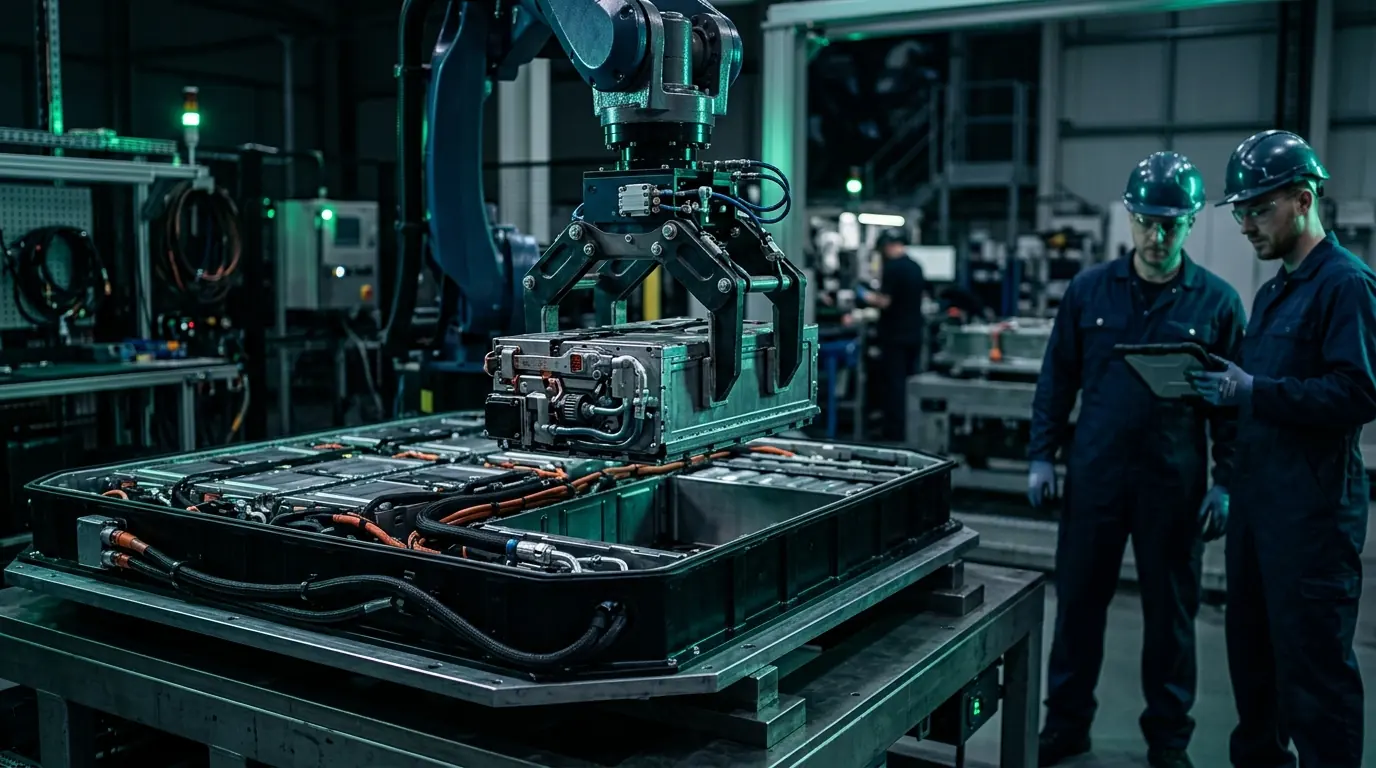
Where automation adds value
Robots are effective at repetitive, well-defined tasks such as removing fasteners, lifting covers, cutting wiring harnesses and moving heavy modules. When packs arrive in consistent designs and sufficient volumes, automated cells can improve throughput and consistency while reducing workers' exposure to high voltage, sharp edges and heavy lifting, which are among the most significant hazards in manual dismantling. Throughput gains are most reliable when pack supply is steady.
Vision systems help robots locate fasteners and components on each pack, while force sensing supports delicate tasks such as separating parts without damaging modules that may be destined for second life. Data captured at every step can feed traceability systems, recording which components were removed, in what condition and at what time, and linking that information to the pack serial number.
- Fastener removal on known pack designs
- Cover and harness removal
- Heavy module handling
- Automated data capture for traceability
Where people still do better
Mixed-model streams are difficult for automation because pack designs vary so widely between manufacturers, models and even production years. Structural adhesives, potting compounds, corrosion and accident damage introduce uncertainty that robots struggle to handle safely. Skilled technicians can adapt to these variations, recognise unexpected hazards and decide in real time how best to proceed with a particular pack. That judgement remains difficult to automate reliably.
Many facilities therefore adopt a hybrid approach. Technicians carry out initial inspection, isolation and any complex or non-standard steps, while automation takes over repetitive tasks for the highest-volume pack models. This combination balances flexibility with efficiency and allows automation investment to be targeted where volumes are predictable enough to justify programming and fixture costs. As volumes of individual models grow, the automated share of work tends to grow with them.
Designing packs for disassembly
Pack design has a major influence on how practical automation can be. Standardised fasteners, accessible connection points, clear chemistry labelling and minimal adhesive bonding make packs easier to open safely and quickly, by robot or by hand. Structural designs that bond cells directly into the vehicle body can bring performance and cost benefits in use, but they make end-of-life processing considerably more complex.
Collaboration between vehicle manufacturers and recyclers pays off here. Sharing dismantling information, and considering end of life during the design phase, can reduce processing costs, improve worker safety and increase the share of modules recovered intact for second-life applications. Those benefits flow back to manufacturers through lower take-back costs and more reliable recycled content supply. Design for disassembly is therefore a shared commercial interest rather than a recycling concern alone.