What the site does
Chakan is one of Maharashtra's densest automotive manufacturing zones, with vehicle assembly, two-wheeler production and a deep bench of tier-one suppliers spread along the Pune–Nashik corridor. The campus opened inside Chakan MIDC Phase II in 2020 to serve that ecosystem directly, taking material from the plants and suppliers around it without the cost and risk of a long first transport leg.
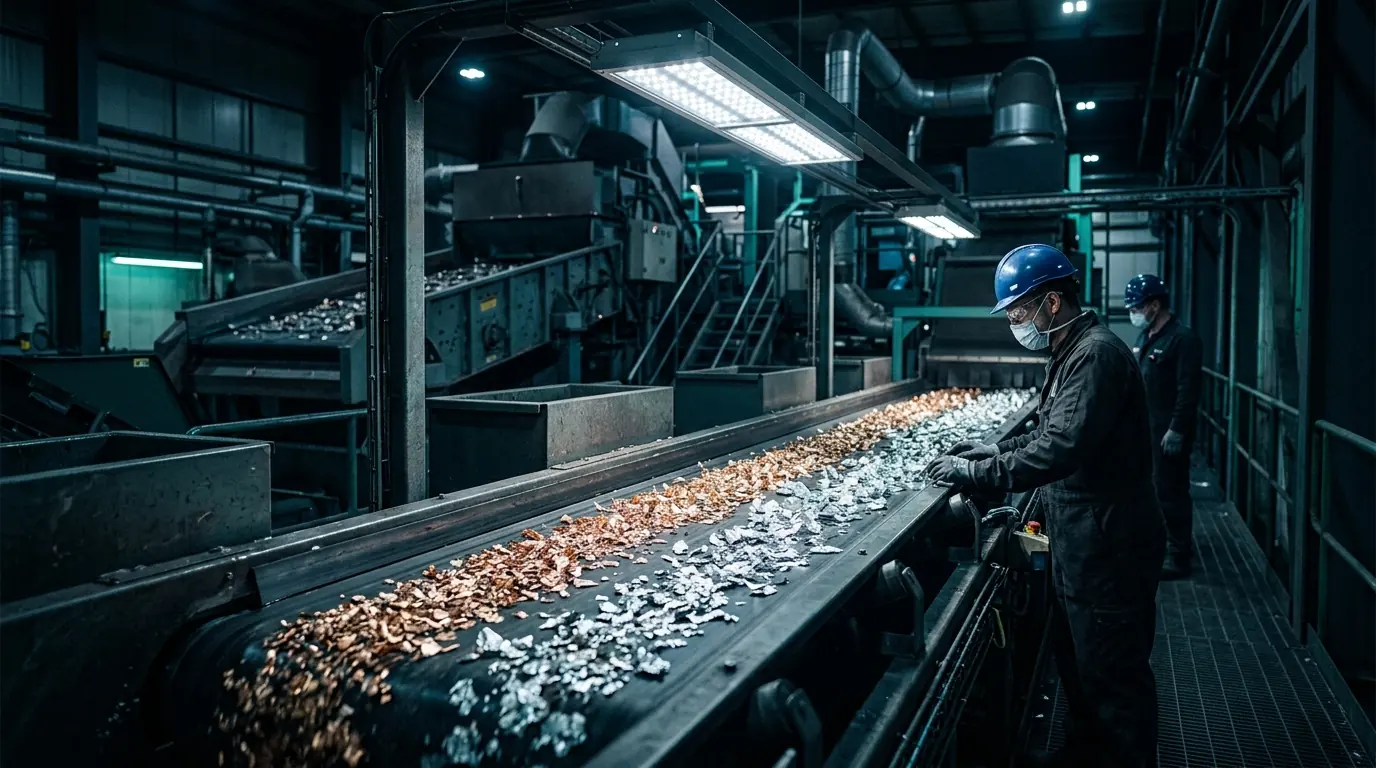
As an integrated campus rated at 24,000 TPA, it runs the whole route on one site: intake, safe discharge, automated disassembly, module grading and shredding to black mass. That makes it the natural destination for production scrap and end-of-line rejects that never leave the Pune belt as finished vehicles, as well as retired two-wheeler, car and light commercial packs from western Maharashtra.
What arrives at the gate
Feedstock at Chakan, Maharashtra reflects its catchment and plant type. Every consignment is weighed, photographed and logged against the originating manifest before it enters the process area.
- Production scrap and end-of-line rejects from the Chakan cluster
- Two-wheeler and three-wheeler packs from western Maharashtra
- Passenger-car packs from Pune dealer networks
- Light commercial packs from logistics fleets on the Mumbai–Pune corridor
The process, step by step
The 3 operating lines — automated disassembly, cell grading & second-life build, black mass production — run the sequence below.
| Stage | What happens |
|---|---|
| Intake inspection | Packs are logged, thermally scanned and quarantined if damaged, defective or water-exposed. |
| Safe discharge | Residual energy is recovered to the site microgrid before any mechanical work begins. |
| Automated disassembly | Robotic cells remove housings, cooling plates and wiring for separate material streams. |
| Grading split | Modules above 75% SOH move to second-life build; everything else is shredded under inert atmosphere. |
| Black mass production | Shredding, drying and multi-stage separation produce a graphite-rich black mass at controlled moisture. |
| Refining handover | Black mass is assayed, sealed and shipped to the assigned hydrometallurgical refinery. |
What sets the site apart
Pack to black mass on one site. Material that fails grading is shredded on campus, so there is no second road journey before black mass production.
Scrap-first intake lane. Clean, single-chemistry production scrap runs through its own lane and skips pack-level diagnostics, shortening turnaround for manufacturers.
Automated disassembly cells. Robotic cells handle standardised two-wheeler and car pack housings, reducing the amount of manual high-voltage work on the floor.
Where material goes next
Material that Chakan, Maharashtra does not finish on site moves to the nearest specialist facility in the network, keeping transport distances and dwell times down.
| Facility | Role | Distance |
|---|---|---|
| Indore — Pithampur Grading Plant | Cell Grading & Diagnostics | 468 km |
| Nagpur — Butibori Second-Life Works | Second-Life BESS Works | 583 km |
| Chennai — Sriperumbudur Recovery Campus | Hydrometallurgical Refinery | 916 km |
Field note