What the site does
Ulsan is South Korea's industrial powerhouse, home to one of the world's largest vehicle production complexes, major shipyards and petrochemical plants. The recovery campus opened in Buk-gu in 2019 to process material from Korea's vehicle and battery industries, close to where much of it is produced. Its catchment covers the south-east of the Korean peninsula, including the Busan and Changwon industrial areas.
At 34,000 TPA, the integrated campus handles packs, modules and production scrap from intake through to black mass. Manufacturing scrap is a large share of its intake, reflecting the scale of Korean battery and vehicle production, alongside retired passenger, bus and commercial packs from domestic fleets. Modules that pass grading are released for second-life use, and black mass from the campus is sent to refining.
What arrives at the gate
Feedstock at Ulsan, South Korea reflects its catchment and plant type. Every consignment is weighed, photographed and logged against the originating manifest before it enters the process area.
- Production scrap from Korean manufacturing
- Passenger-car packs from domestic fleets
- Commercial vehicle and bus packs
- Warranty returns
The process, step by step
The 3 operating lines — automated disassembly, cell grading & second-life build, black mass production — run the sequence below.
| Stage | What happens |
|---|---|
| Intake inspection | Packs are logged, thermally scanned and quarantined if damaged, defective or water-exposed. |
| Safe discharge | Residual energy is recovered to the site microgrid before any mechanical work begins. |
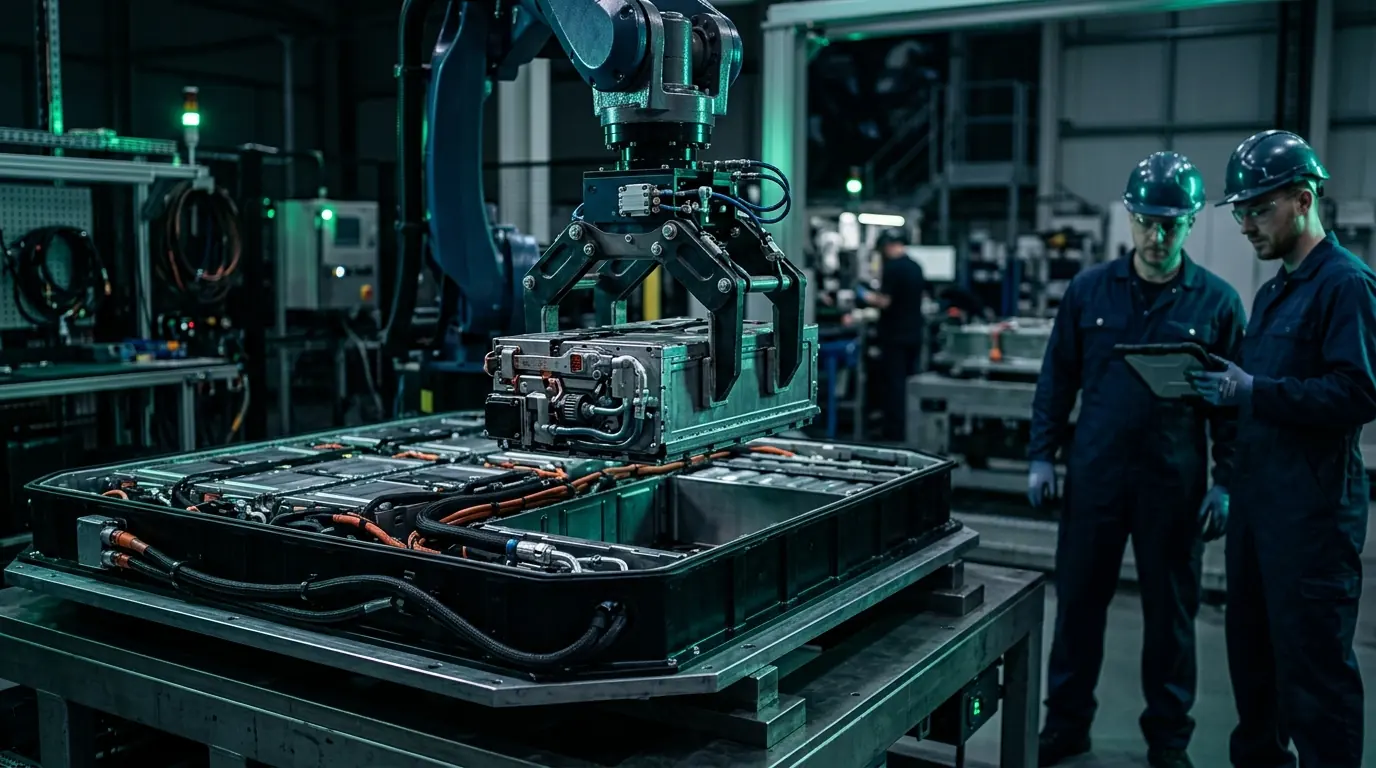
| Automated disassembly | Robotic cells remove housings, cooling plates and wiring for separate material streams. |
| Grading split | Modules above 75% SOH move to second-life build; everything else is shredded under inert atmosphere. |
| Black mass production | Shredding, drying and multi-stage separation produce a graphite-rich black mass at controlled moisture. |
| Refining handover | Black mass is assayed, sealed and shipped to the assigned hydrometallurgical refinery. |
What sets the site apart
Industrial-city location. Next to large vehicle, shipbuilding and chemical industries.
Full processing route. Grading, disassembly and black mass production on one site.
High-volume scrap. Handles large volumes of manufacturing scrap.
Where material goes next
Material that Ulsan, South Korea does not finish on site moves to the nearest specialist facility in the network, keeping transport distances and dwell times down.
| Facility | Role | Distance |
|---|---|---|
| Yokohama — Kanagawa Diagnostics Works | Cell Grading & Diagnostics | 935 km |
| Gothenburg — Nordic Second-Life Campus | Second-Life BESS Works | 8,121 km |
| Ningde — Fujian Refining Base | Hydrometallurgical Refinery | 1,354 km |
Field note