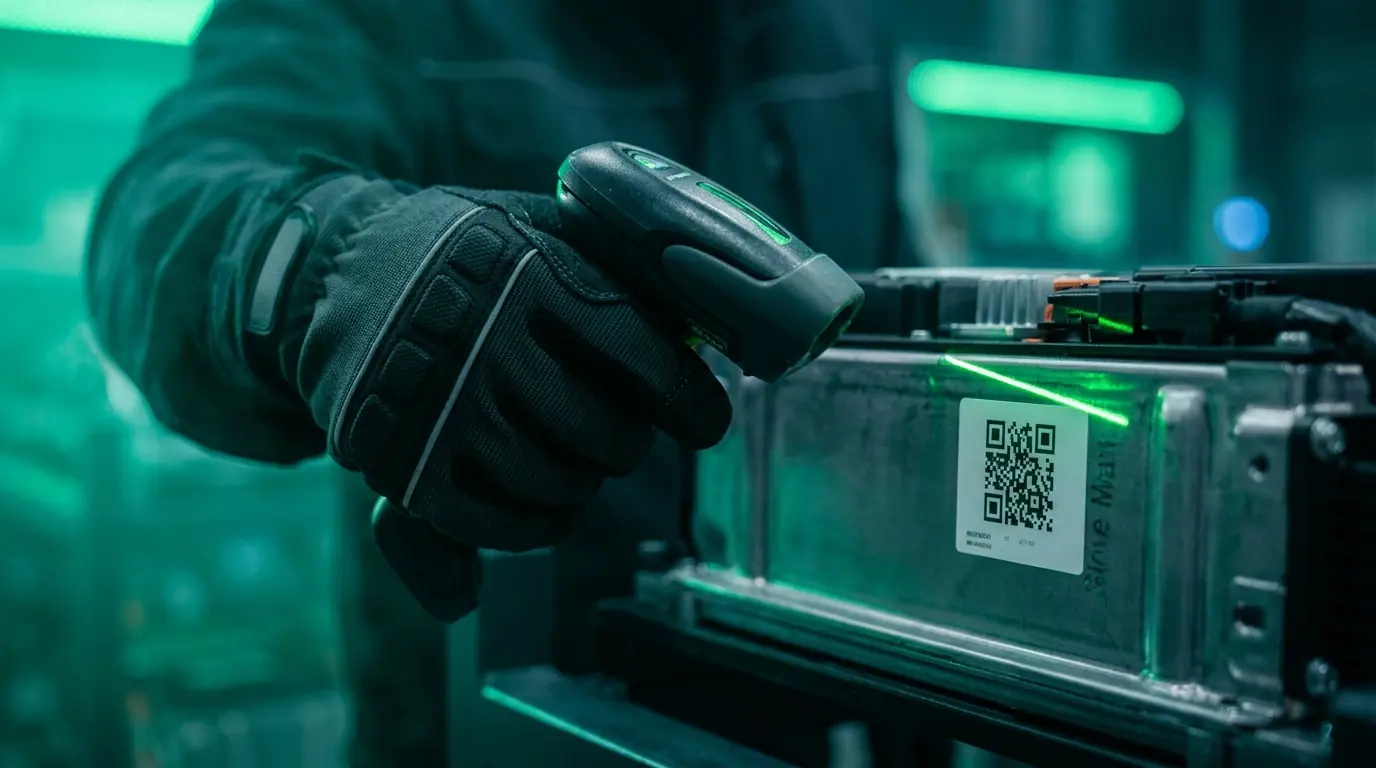
What serial discipline means in practice
Every pack and, wherever possible, every module should carry a durable, readable identifier that is recorded at each handover: removal from the vehicle, storage, collection, intake, grading and final routing. Identifiers should be captured by scanning rather than manual typing, because transcription errors are one of the most common ways that records drift apart from the physical batteries they are meant to describe.
Those records should link each serial number to the vehicle it came from, its test data, condition declarations, transport documents and eventual certificates. Together they form a complete chain of custody running from the vehicle to recovered material or a second-life system. Without that chain, it becomes very difficult to prove what happened to any individual battery once it has left the owner's site.
- Scan serials at every handover
- Link serials to vehicle, tests and documents
- Relabel damaged or unreadable identifiers immediately
- Reconcile serial counts with manifests
Why it pays
Serial tracking supports warranty claims by proving exactly which unit failed and how it was handled afterwards. It supports second-life sales because buyers can see each module's history and test results, which justifies a higher price. It supports compliance by showing regulators, auditors and customers precisely where each battery went and what certificate was issued for it. That transparency increasingly influences how customers and investors judge an organisation.
In the European Union, battery passport requirements will make structured data about relevant batteries mandatory from February 2027. Organisations that already track serial numbers consistently across their operations will find those requirements far easier to meet, because the underlying data discipline is already in place rather than having to be built under deadline pressure. Early adopters also gain cleaner data for their own operational decisions and reporting.
Field note
Common failure points
Labels can be damaged by heat, abrasion, handling or cleaning. Different teams may relabel packs inconsistently, and modules can become separated from their pack records during dismantling if no one records which module came from which pack. Each of these failures breaks the chain of custody and forces assumptions later, which weakens certificates and undermines any claim built on that data.
Regular reconciliation catches problems early. Comparing scanned serials with manifests at collection and again at intake, and investigating every mismatch immediately, keeps records reliable. A clear procedure for relabelling damaged identifiers, including photographs and a cross-reference to the original number, prevents small gaps from becoming permanent holes in the audit trail. Periodic sample audits, comparing physical labels with system records, add a further check that the process is working as intended.